
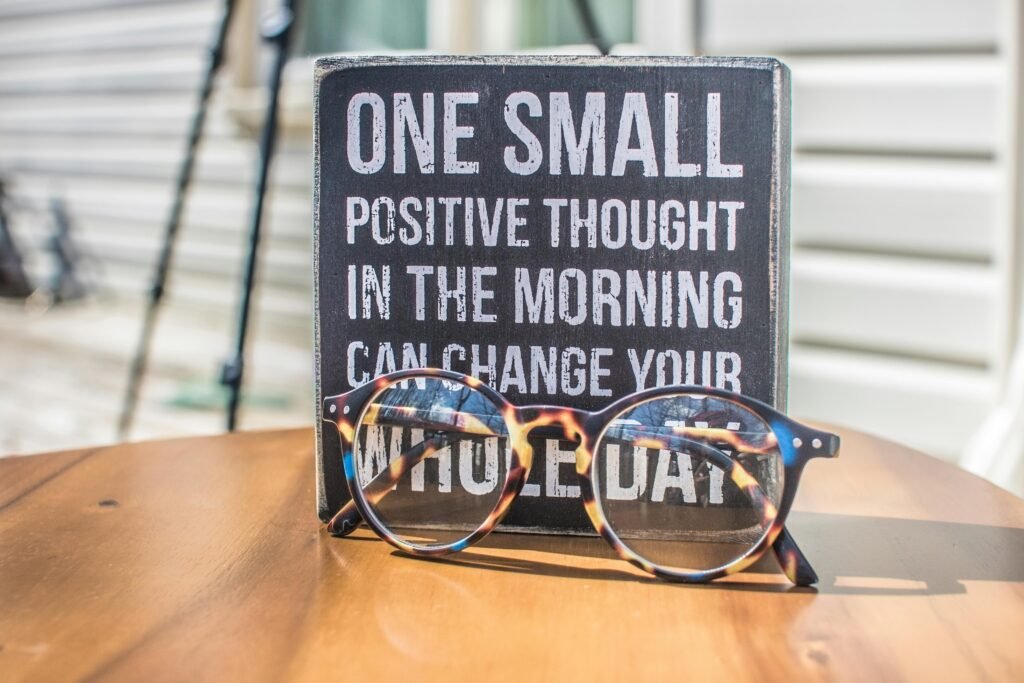
Are you dealing with constant whining and complaining from your kids? Do you feel like every conversation turns negative? I get it—I was in the exact same place. Last month, I noticed that my kids were complaining a lot. At the elementary school that my kids attend, there is an annual theme of “Positivity”. I adopted that theme, because less complaints means more positivity, and created a Positivity Contest – A contest for the month of September to see who could complain the least.
Why Do Kids Complain So Much? The Psychology Behind It
There’s a study by psychologist Richard Wiseman that looked at people and their perception of luck. Wiseman spent a decade researching why some people seem to consistently get lucky while others don’t.
In one of his experiments, he gave participants a newspaper and asked them to count the number of photographs inside. What the participants didn’t know was that on the second page, there was a huge message in large, bold letters that said “Stop counting — there are 43 photographs in this newspaper.” The message took up almost half the page. There was even another large message that said,
The people who considered themselves unlucky spent around two minutes counting all the photos—they completely missed both messages because they were so focused on the task. The people who considered themselves lucky saw the message in just seconds, stopped counting, and some even collected the reward money.
Wiseman’s research showed that it wasn’t really about luck at all. The “unlucky” people were generally more tense and anxious, which made them focus so narrowly that they missed opportunities that were right in front of them. The “lucky” people were more relaxed and open, so they actually saw what was there.
So it’s about that missed opportunity. We wanted to instill this positive psychology in the kids, so this concept was all about less complaining, more positivity.
How Did We Set Up Our Family Complaint Contest?
So we called it the September Positivity Project and it was both ways as well. The kids were able to mark when mommy complained or when my husband complained as well. For example, one week my husband and I were arguing in the car, so the kids gave us five complaint checkmarks each.
We tracked this over the month and my eldest daughter won and received a Yes Day.
What is a Yes Day and How Does It Work as a Reward?
If you’re not familiar with the concept of Yes Day, there’s a Netflix movie called “Yes Day” (released in 2021) featuring Jennifer Garner. In the movie, she plays a mom who, along with her husband, decides to say yes to their kids’ wildest requests for an entire day—within some ground rules, of course. The movie is based on a children’s book by Amy Krouse Rosenthal and Tom Lichtenheld.
We have adopted that concept for special occasions. We do Yes Days for birthdays and this was a prize in that they get a day as a reward for having the least number of complaints. It’s a non-monetary reward, a reward which is really about the day of being able to enjoy themselves and instilling this new habit of less complaints.
Did the Positivity Contest Actually Work?
We found that the complaints went down significantly. Then we decided to do another contest for the month of October which I’ll talk about in a later post.
What Happened When Other Families Tried This
This project received a lot of positive feedback. We do have friends over quite a bit at our house and the kids would ask about the positivity project. So ironically, what has happened is several other families have adopted this contest in their house as well.
Why Does a Positivity Contest Reduce Complaining?
There’s a lot of positive psychology around not complaining and seeing positive things. When we focus on what’s wrong all the time, we miss opportunities that are right in front of us. The positivity project helps kids (and parents!) become more aware of their patterns and choose differently.
By creating some healthy competition between the kids and using a reward that’s about experience rather than money, we were able to get everyone engaged. And because parents participate too, it’s not about us versus them—it’s about all of us working on this together.
How Can I Start a Positivity Project With My Kids?
If you want to try this with your family, here’s what worked for us:
**Set up your tracking system.** We used a simple chart where anyone could mark complaints. Make it visible—ours was on the fridge.
**Decide what counts as a complaint.** We defined it as general whining versus legitimate problem-solving. “I don’t understand this homework” isn’t a complaint. “Why do I have to do homework?” is.
**Include everyone.** Parents have to participate too. This is really important for buy-in.
**Pick your reward.** It doesn’t have to be a Yes Day. Choose something meaningful to your family.
**Track for a set time period.** We did a month, but you could start with a week or do longer.
**Keep it positive.** This isn’t about punishing complaints—it’s about creating awareness and celebrating progress.
Going back to that study about seeing opportunities—what we’re really doing is training our kids to keep their eyes open. When they’re less focused on complaining, they’re more likely to notice good things, opportunities, and solutions instead of just problems.
This isn’t about pretending problems don’t exist. It’s about choosing what we focus on and training ourselves to see the full picture.
Can A Positivity Contest Work for Startup Teams and Businesses?
As a marketing consultant who works with startups, I see the same patterns in business. How much time do teams spend in complaint mode versus solution mode? When teams become more aware of negative communication patterns and consciously redirect toward constructive dialogue, everything changes. Innovation increases, morale improves, solutions emerge faster.
You could implement a version of this with your team. Track unproductive complaints versus productive problem identification. Reward solution-oriented thinking.
FINAL THOUGHTS
I thought I would share this as a great way to get the kids involved, bring down complaints, create a more positive outlook, create some healthy competition between the kids, and use a non-monetary reward that’s really about enjoying the day together and instilling this new habit of less complaints.
The September Positivity Project didn’t cost anything except awareness and effort. No expensive programs, no complicated systems. And the results? A happier household and kids who are more aware of their patterns.
If you’re dealing with a lot of complaints at home, give this a try. Start with a week if a month feels like too much. Track it, make it fun, and include everyone.
—–
**Have you tried something like this with your family? I’d love to hear about your experience in the comments.**
—–
## References
**Richard Wiseman’s Luck Study:**
– Wiseman, Richard. *The Luck Factor: The Scientific Study of the Lucky Mind* (2003)
– The newspaper experiment is detailed in Wiseman’s research on luck and perception, where participants who identified as “lucky” noticed opportunity messages while “unlucky” participants missed them due to narrowed focus
**Yes Day Movie:**
– *Yes Day* (2021), directed by Miguel Arteta, starring Jennifer Garner, Édgar Ramírez, and Jenna Ortega
– Released on Netflix, March 12, 2021
– Based on the children’s book by Amy Krouse Rosenthal and Tom Lichtenheld
—–
*Keywords: how to get kids to stop complaining, ways to reduce complaining in children, positivity project for families, complaint contest for kids, how does a Yes Day work, positive psychology for children, family challenge to stop whining, does tracking complaints help kids, non-monetary rewards for children, healthy competition between siblings, how to teach kids gratitude, parenting tips to reduce negativity, what is the Yes Day movie about, Jennifer Garner Yes Day, Richard Wiseman luck study, positive parenting strategies that work, how to create a positivity project at home, teaching kids to see opportunities, complaint tracking chart for families, startup team positivity, reducing complaints in business teams, how to instill positive habits in kids, best rewards for behavior change, family contests that build character, psychology of complaining, why do kids complain so much*